FM8.plus
An enhancement layer for Native Instruments FM8 on Windows and macOS
Gives Native Instruments FM8 what it never got: the arpeggiator can play your other instruments, the morph square follows your mod wheel, the arp runs free of the DAW tempo, the interface scales up, and there is finally enough output gain. VST2, VST3 and standalone on Windows, VST2, VST3 and Audio Unit on macOS.
 James Hansen
v1.0.9free and open sourceWindows, macOSfor FM8 v1.4.6, and v1.4.1 on Windows
downloads. v1.0.9
v1.0.9 on GitHub, with checksums and older versions →



what it adds.
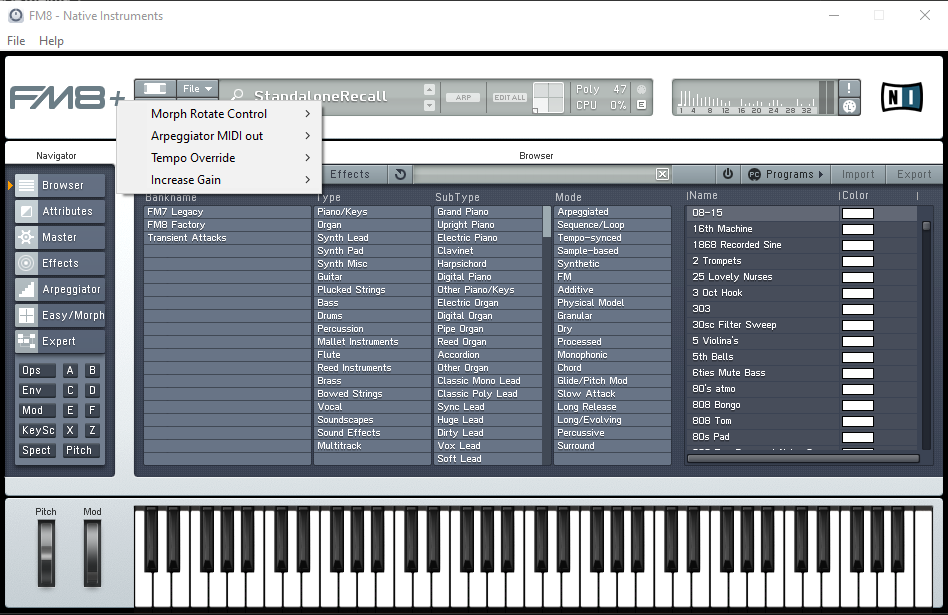
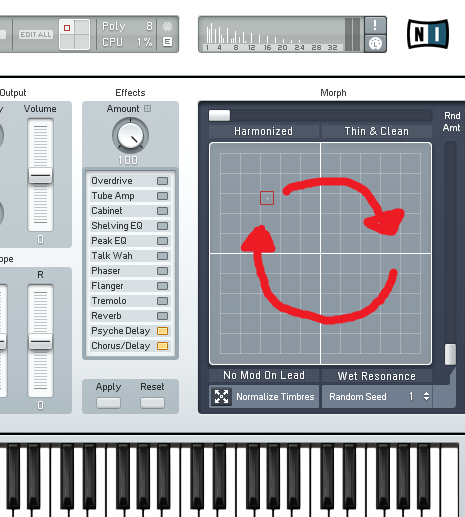
- Morph RotateMap any MIDI CC to sweep a circle through all four morph timbres. The on-screen handle follows, and the CC is blocked from its normal FM8 job so it drives only the morph.
- Arp MIDI outThree modes: stock, clone the arp notes to the MIDI output while FM8 plays them, or send them out with FM8's own voices silent so one FM8 drives another instrument.
- Tempo overrideRun the arpeggiator at 0.25x, 0.5x, 2x or 4x of the host tempo, or cut it loose entirely and use FM8's own Tempo control.
- GUI scale2x, 3x or 4x in whole numbers, replicating pixels instead of interpolating, so the artwork comes out sharp rather than blurred. Window, mouse and interface all scale together, and the setting is remembered for every FM8.plus window.
- Output gainUp to ten decibels of extra output, applied post-fader, for patches that never quite got loud enough.
- The DXi, restoredNI dropped the DXi after FM8 1.0.3. FM8.plus brings it back on FM8 1.4.1 for 32-bit hosts such as SONAR, with every feature except arp MIDI out, since a DXi has no way to send MIDI to the host.
why it exists.
I use FM8 on a lot of the tracks on this site. It has had no meaningful feature updates in years, and its final build, v1.4.6, shipped in December 2022. Everything FM8+ adds is either something I wanted for my own music or something FM8 owners have been asking for on forums for a long time.
Arpeggiator MIDI output is probably the most requested missing feature, appearing on Reddit and forums everywhere. The morph rotate idea was my own. The morph square allows for incredible texture variations and transitions, and I wanted to ride through them with a mod wheel. I asked Native Instruments for exactly that on their old forum in 2013, complete with a diagram. Nothing came of it. Thirteen years later it felt a little surreal to implement the feature myself. The tempo and gain ideas came off a Reddit wishlist.
What changed is the tooling. FM8 is closed source, so the only way to add anything to it is to read its compiled machine code, which used to mean months of work before writing a single line. A model can now read that disassembly at a level close to the original source. The reverse engineering notes are written up on GitHub.
GUI Scale needed no drawing code at all: FM8 already carries a DPI layer, finished and switched off, so FM8.plus flips the gate and hands it a number and FM8 scales itself. v1.4.1, the last FM8 with a 32-bit plug-in, is supported alongside the final build, and with it the DXi is back for SONAR and the other 32-bit DXi hosts NI left behind after FM8 1.0.3.
The macOS port followed in September 2026 with Claude Opus 5.5. NI's Mac binaries keep their C++ symbol names, so FM8.plus finds every function it needs by name, and one build covers the VST2, VST3 and Audio Unit on Intel and Apple Silicon. Apple Silicon will not run modified code, so the arpeggiator is reached through a hardware breakpoint rather than a patch, which means nothing in memory changes and code signing has nothing to object to. If you use FM8 and there is something you have always wanted from it, check out the release thread on Native Instruments' forums.
the 2013 idea.
the community.
There is a FM8.plus channel on the musica.studio Discord. Bug reports, feature requests, questions, and screenshots of what you made with it all go there, and it is the fastest way to reach me about this project.
good to know.
FM8.plus never touches your copy of FM8. On Windows the installer adds its own files beside it, a VST2 in both bit depths, a VST3, a standalone launcher and optionally the DXi. On macOS it adds a VST2, VST3 and Audio Unit to /Library/Audio/Plug-Ins. Each one loads the real FM8 when you open it. It appears in your DAW as "FM8.plus", old projects keep loading stock FM8, the two sit side by side, and an update or repair from Native Access cannot break either one. Uninstalling leaves FM8 exactly as it was.
Every hook is checked against the FM8 build it is attaching to. If it meets a build it does not recognise, it loads it as plain FM8 and stays out of the way. Free and open source under the GPLv3, with no Native Instruments code or artwork in the repository.
The Mac package is not yet signed with an Apple Developer ID, so macOS will say it comes from an unidentified developer. Right-click the package and choose Open, or allow it under System Settings, Privacy & Security.